tirsdag den 4. marts 2014

Some Clarifications Regarding Ukraine http://projectmaidan.com/

MARCH 3, 20141:08 AM

Some Clarifications Regarding Ukraine

By Capt Stephen L. Szyszka (Ret.)
With the recent developments in Ukraine, I feel obligated to take a new approach. Certain disinformation, repeated by many media outlets and intellectuals (some would say, provocateurs) in the West, like Stephen Cohen of Princeton, has been raging for months, and now it is in full attack mode. I will repeat certain of these assertions, and then provide a clarification of the same.
image
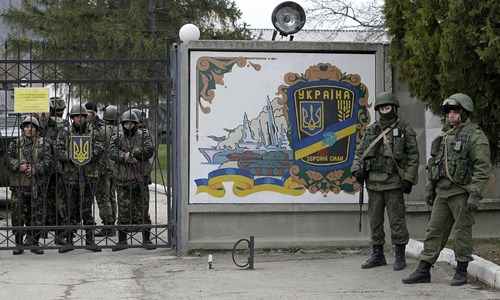
Ukrainian soldiers (left) and unidentified gunmen (right) at the gate of a Crimean infantry base. Photo: Darko Vojinovic/AP
The inaccurate assertions below are repeated by certain Western media outlets and intellectuals, and I feel obligated to provide clarifications.
  1. Assertion: The new government in Ukraine is illegitimate, and Yanukovych is still the duly-elected president. The only way forward is to accept the agreement between Yanukovich and opposition political leaders of Febuary 21st as witnessed by three European Foreign Ministers which established a power-sharing arrangement keeping Yanukovych in power through December.

    Clarification: Yanukovych’s security forces were executing a plan in which hired Russian snipers assassinated dozens of peaceful protesters during the negotiation of this agreement in the single greatest day of carnage since the protests began. Only after this did some more extreme faction of the protesters, a tiny minority, armed in order to defend themselves. Due to Yanukovych’s bad-faith negotiation, the agreement to which they refer is meaningless. Additionally, the agreement required Yanukovych to sign the Parliament’s restoration of the 2004 Constitution within a reasonable time frame, which he did not. Subsequently, the Parliament, in full complement (no ruling party members were excluded and in fact many of them voted with the opposition), voted to impeach Yanukovych, and subsequently ordered his arrest. Hence, Yanukovych is not the president, he is a fugitive from justice.
  2. Assertion: Yanukovych did not flee his office. He was chased out by armed extremists who were shooting at him and his family.

    Clarification: this is an outright lie. There is no evidence of such shootings.
  3. Assertion: The protesters/perpetrators of the coup are neonazi fascists who intend to create an ethnically pure Ukrainian state, specifically targeting Russians for discrimination and repression.

    Clarification: The protesters consist of Ukrainians, Russians, Georgians, Armenians, Orthodox, Catholic, Protestant, Jewish and Muslim religious leaders. Many of these groups are represented in the new government, as well. Even the Moscow-controlled faithful of the Ukrainian Orthodox Church-Moscow Patriarchate are calling out these lies in Russian and Eastern Ukrainian media. No incidents of Ukrainians infringing on the rights of any ethnic or religious minority have been documented.
  4. Assertion: Crimea is historically Russian land, importunely gifted to Ukraine by Khrushchev, that is so ingrained in Russian DNA that it must be returned to Russia, as are the Eastern portions of Ukraine, for that matter.

    Clarification
    : At best, this is selective history. At worst, it is ongoing disinformation. Crimea was annexed into the Russian Empire in the 17th century by Catherine the Great. Prior to this annexation, Crimea was often conquered and reconquered, by Asian Hordes in the first millennium, by the Ottomans, Cossacks, and others over the years. So if history goes back only to 1700, those Russian chauvinists who claim Crimea is “ancient Russian land” are correct. If one goes back to 1960, Ukrainians can make the same claim. If one goes back to A.D. 1000, Ukraine’s precursor state centered in Kyiv once again has the legitimate claim. If one goes to 1200, Mongolia has that right, so those Russians who claim indignantly that this is their land from time immemorial are not presenting an accurate picture of history. Those who can arguably claim the greatest right to Crimea are the Muslim Tatars who had lived there since that first millennium, until forcibly expatriated by Russian/Soviet policy. Only recently have they been allowed to return to their ancient homeland, and although a minority of ~14% in Crimea, that have made it clear that they want to live in a democratic Ukraine and not in an authoritarian Russia. As for the Russians in Eastern Ukraine, they are only there because the Holodomor (Famine-Genocide) of the 1930s starved to death millions of Ukrainians, and Russians were sent their to repopulate the land and work the farms.
  5. Assertion: Extremists started the violence on the maidan, and the government showed great restraint until forced into the military option.

    Clarification
    : There is ample evidence and testimony that the protesters were peaceful and unarmed from November through the middle of January. Throughout, the government attempted to incite them to violence through the use of hired titushky thugs, who infiltrated the Maidan, stirring up trouble, giving the militia an excuse to employ force. There is video evidence and testimony of these people being rounded up, hired, conspiring with the Berkut special forces, and then slipping from one side of the barricades to the other, stirring up violence. These same thugs hired by the mayor of Kharkiv, Kenes, were responsible for multiple kidnappings and beatings, maiming and deaths of not only protesters, but also medical personnel and journalists. Every time the government negotiated with the opposition, force was employed against the protesters, testifying to Yanukovych’s lack of good faith. The January 18th assassinations were the final straw.
  6. Assertion: Russian forces in Crimea are only defending Russian interests and citizens against the provocations of an illegal government installed in Kyiv.

    Clarification: There is zero evidence of such provocations. As previously in Kyiv, armed, well-organized, unmarked militiamen appeared and surrounded a number of key facilities (communications nodes, police facilities, government buildings) and set up roadblocks restricting movement in Crimea without provocation. They forbade duly-elected members of the Crimean parliament from entering the building, and only certain members were allowed in. Subsequently, with only 42 of 100 parliament members allowed in the chamber, they elected a new speaker (illegal, since he is a Russian citizen, not Ukrainian) and requested that Russia send in forces to protect them. It has been demonstrated that these unmarked lads are Russians, as one of them let it slip to an interviewer, whereas the bulk of them refuse to answer. They prohibit journalists from access and doing their job. If they are doing such honorable work, why are they afraid of openness? The phone links to Ukraine are blocked. The only TV broadcasts permitted are those originating in Russia, and they-the Russia-controlled media-are fueling this hysteria. Further, showing pro-Russia protests in Crimea is inaccurate, since those who would protest against Russian intervention are beaten and forced to remain indoors. To reiterate, there are not any western provocateurs in Crimea, and none have been shown to be there.
  7. Assertion: This coup is hostile to Russian citizens, ethnic Russians, and Russian-speakers. The evidence they cite here is the toppling of Lenin statues all over the country, and the banning of the Russian language by Parliament.

    Clarification: Lenin brought about the most vile, destructive and repressive empire in recorded history and ought not be revered by anybody, most specifically the Russian people. His actions resulted in their subjugation for 70 years, and it is high time to topple all of these statues. Regardless, toppling a statue of Lenin is not anti-Russian, it is Anti-Soviet Union and should be welcomed by all post-Soviet nations. Secondly, there is no such law banning the Russian language in Ukraine.  What the Parliament did is repeal a law that had elevated the Russian language in Ukraine to the level of a state language. This in no way limits people’s rights to function using that language. Newspapers, radio and TV broadcasts, schools, shops, all can and likely will continue functioning in Russian. People can and will continue speaking Russian if that is their preferred language.

Finally, there are many instances and examples of Russian people (citizens, ethnics, speakers, etc.) in Ukraine’s east, in Russia, and around the world, who are appalled at Putin’s adventurism, who stand for a free and democratic Ukraine with whom Russia should have normal “equal-partner” relations. And in Russia, those who dare voice their support for a free Ukraine are jailed, whilst others are instructed by their employers to go protest in support of the occupation, and show no passion for the cause. It is not the Russian people writ large who are in favor of this invasion. It is only the chauvinistic minority who cling to outdated stereotypes, and refuse to acknowledge the realities of today. This invasion is not supported by the Russian people. It is a fabrication of the cynical Russian leadership.

fredag den 21. februar 2014

Ukrainske experter om Euromaidan og 'højre-fraktion' change.org

Collective statement by experts on Ukrainian nationalism on the role of far right groups in Ukraine’s protest movement, and a warning about the Russian imperialism-serving effects of some supposedly anti-fascist media reports from Kyiv

We are a group of researchers who comprise specialists in the field of Ukrainian nationalism studies, and most of the world’s few experts on the post-Soviet Ukrainian radical right. Some of us publish regularly in peer-reviewed 
journals and with academic presses. Others do their research within governmental and non-governmental organizations specializing on the monitoring of xenophobia in Ukraine.
As a result of our professional specialization and research experience, we are aware of the problems, dangers and potential of the involvement of certain right-wing extremist groupings in the Ukrainian protests. Following years of intensive study of this topic, we understand better than many other commentators the risks that its far right participation entails for the EuroMaidan. Some of our critical comments on nationalist tendencies have triggered angry responses from ethnocentrists in Ukraine and the Ukrainian diaspora living in the West.
While we are critical of far right activities on the EuroMaidan, we are, nevertheless, disturbed by a dangerous tendency in too many international media reports dealing with the recent events in Ukraine. An increasing number of lay assessments of the Ukrainian protest movement, to one degree or another, misrepresents the role, salience and impact of Ukraine’s far right within the protest movement. Numerous reports allege that the pro-European movement is being infiltrated, driven or taken over by radically ethnocentrist groups of the lunatic fringe. Some presentations create the misleading impression that ultra-nationalist actors and ideas are at the core or helm of the Ukrainian protests. Graphic pictures, juicy quotes, sweeping comparisons and dark historical references are in high demand. They are combined with a disproportionate consideration of one particularly visible, yet politically minor segment within the confusing mosaic that is formed by the hundreds of thousands of protesters with their different motivations, backgrounds and aims.
Both the violent and non-violent resistance in Kyiv includes representatives from all political camps as well as non-ideological persons who may have problems locating themselves politically. Not only the peaceful protesters, but also those using sticks, stones and even Molotov Cocktails, in their physical confrontation with police special units and government-directed thugs, constitute a broad movement that is not centralized. Most protesters only turned violent in response to increasing police ferocity and the radicalization of Yanukovych’s regime. The demonstrators include liberals and conservatives, socialists and libertarians, nationalists and cosmopolitans, Christians, non-Christians and atheists.
True, the violent and non-violent protesters also comprise a variety of radicals of both the far right and far left. Yet, the movement as a whole merely reflects the entire Ukrainian population, young and old. The heavy focus on right-wing radicals in international media reports is, therefore, unwarranted and misleading. Such an over-representation may have more to do with the sensationalist potential of extremely ethnonationalistic slogans, symbols or uniforms than with the actual situation, on the ground.
We even suspect that, in some semi-journalistic reports, especially those in Kremlin-influenced mass media, the inordinate attention to far right elements in Ukraine’s protest movement has nothing to do with anti-fascism. Paradoxically, the production, biases and dissemination of such reports may themselves be driven by an imperial form of ultra-nationalism - in this case, its Russian permutation. By fundamentally discrediting one of the most impressive mass actions of civil disobedience in the history of Europe, such reports help to provide a pretext for Moscow’s political involvement, or, perhaps, even for a Russian military intervention into Ukraine, like in Georgia in 2008. (In a revealing blog, Anton Shekhovtsov has recently detailed the activities of some obviously pro-Kremlin institutions, connections and authors. See “Pro-Russian network behind the anti-Ukrainian defamation campaign” at http://anton-shekhovtsov.blogspot.com/2014/02/pro-russian-network-behind-anti.html. Probably, there are more of them.)
In light of these threats, we call upon commentators, especially those on the political left, to be careful when voicing justified criticism of radical Ukrainian ethnonationalism. The more alarmist statements on the EuroMaidan are likely to be used by the Kremlin’s “political technologists” for the implementation of Putin’s geopolitical projects. By providing rhetorical ammunition for Moscow’s battle against Ukrainian independence, such alarmism unintentionally helps a political force which is a far more serious threat to social justice, minority rights and political equality than all Ukrainian ethnocentrists taken together.
We also call upon Western commentators to show empathy with a nation-state that is very young, unconsolidated and under a serious foreign threat. The fragile situation in which Ukraine’s nation still finds itself and the enormous complications of everyday life in such a transitional society give birth to a whole variety of odd, destructive and contradictory opinions, behaviors and discourses. Support for fundamentalism, ethnocentrism and ultra-nationalism may sometimes have more to do with the permanent confusion and daily anxieties of the people living under such conditions than with their deeper beliefs.
Finally, we call upon all those who have either no particular interest for, or no deeper knowledge of, Ukraine to not comment on this region’s complicated national questions without engaging in some in-depth research. Being specialists in this field, some of us struggle every day to adequately interpret the growing political radicalization and para-militarization of the Ukrainian protest movement. In face of what can only be called state-terror against Ukraine’s population, an increasing number of both ordinary Ukrainians and high-brow Kyiv intellectuals are concluding that, although surely preferable, non-violent resistance is impractical. Reporters who have the necessary time, energy and resources should visit Ukraine, or/and do some serious reading on the issues their articles address. Those who are unable to do so may want to turn their attention to other, more familiar, uncomplicated and less ambivalent topics. This should help to avoid, in the future, the unfortunately numerous clichés, factual errors, and misinformed opinion that often accompany discussions of events in Ukraine.

S I G N A T U R E S:
Iryna Bekeshkina, researcher of political behavior in Ukraine, Sociology Institute of the National Academy of Sciences, Ukraine
Tetiana Bezruk, researcher of the far right in Ukraine, Kyiv-Mohyla Academy, Ukraine
Oleksandra Bienert, researcher of racism and homophobia in Ukraine, PRAVO. Berlin Group for Human Rights in Ukraine, Germany
Maksym Butkevych, researcher of xenophobia in post-Soviet Ukraine, “No Borders” Project of the Social Action Center at Kyiv, Ukraine
Vitaly Chernetsky, researcher of modern Ukrainian and Russian culture in the context of globalization, University of Kansas, USA
Marta Dyczok, researcher of Ukrainian national identity, mass media and historical memory, Western University, Canada
Kyrylo Galushko, researcher of Ukrainian and Russian nationalism, Institute of Ukrainian History, Ukraine
Mridula Ghosh, researcher of human rights abuses and the far right in Ukraine, East European Development Institute, Ukraine
Olexiy Haran, researcher of Ukrainian political parties, Kyiv-Mohyla Academy, Ukraine
John-Paul Himka, researcher of Ukrainian nationalist participation in the Holocaust, University of Alberta, Canada
Ola Hnatiuk, researcher of right-wing tendencies in Ukraine, University of Warsaw, Poland
Yaroslav Hrytsak, researcher of historic Ukrainian nationalism, Ukrainian Catholic University at L’viv, Ukraine
Adrian Ivakhiv, researcher of religio-nationalist groups in post-Soviet Ukraine, University of Vermont, USA
Valeriy Khmelko, researcher of ethno-national structures in Ukrainian society, Kyiv International Institute of Sociology, Ukraine
Vakhtang Kipiani, researcher of Ukrainian nationalism and samizdat, "Istorychna pravda" (www.istpravda.com.ua), Ukraine
Volodymyr Kulyk, researcher of Ukrainian nationalism, identity and media, Institute of Political and Ethnic Studies at Kyiv, Ukraine
Natalya Lazar, researcher of the history of the Holocaust in Ukraine and Romania, Clark University, USA
Viacheslav Likhachev, researcher of Ukrainian and Russian xenophobia, Euro-Asian Jewish Congress, Israel
Mykhailo Minakov, researcher of Russian and Ukrainian political modernization, Kyiv-Mohyla Academy, Ukraine
Michael Moser, researcher of languages and identities in Ukraine, University of Vienna, Austria
Bohdan Nahaylo, researcher of ethnic tensions in Eastern Europe and the CIS, formerly with UNHCR, France
Volodymyr Paniotto, researcher of post-Soviet xenophobia, Kyiv International Institute of Sociology, Ukraine
Olena Petrenko, researcher of war-time Ukrainian nationalism, Ruhr University of Bochum, Germany
Anatolii Podolskyi, researcher of genocide history and antisemitism, Ukrainian Center for Holocaust Studies at Kyiv, Ukraine
Alina Polyakova, researcher of radical right movements, University of Bern, Switzerland
Andriy Portnov, researcher of modern Ukrainian, Polish and Russian nationalism, Humboldt University of Berlin, Germany
Yuri Radchenko, researcher of war-time Ukrainian nationalism, Center on Inter-Ethnic Relations in Eastern Europe at Kharkiv, Ukraine
William Risch, researcher of Ukrainian nationalist thought and politics, Georgia College, USA
Anton Shekhovtsov, researcher of West and East European right-wing extremism, University College London, United Kingdom
Oxana Shevel, researcher of Ukrainian national identity and historical memory, Tufts University, USA
Myroslav Shkandrij, researcher of inter-war Ukrainian radical nationalism, University of Manitoba, Canada
Konstantin Sigov, researcher of post-Soviet discourse strategies of the “Other,” Kyiv-Mohyla Academy, Ukraine
Gerhard Simon, researcher of contemporary Ukrainian history and nationality affairs, University of Cologne, Germany
Iosif Sissels, researcher of hate speech and antisemitism, Association of Jewish Organizations and Communities (VAAD) at Kyiv, Ukraine
Timothy Snyder, researcher of historic Ukrainian nationalism, Yale University, USA
Kai Struve, researcher of Ukrainian radical nationalism and the Holocaust, University of Halle, Germany
Mykhaylo Tyaglyy, researcher of genocide and antisemitism, Ukrainian Center for Holocaust Studies at Kyiv, Ukraine
Andreas Umland, researcher of the Russian and Ukrainian post-Soviet extreme right, Kyiv-Mohyla Academy, Ukraine
Taras Voznyak, researcher of Ukrainian intellectual life and nationalism, Magazine “JI” (L’viv), Ukraine
Oleksandr Zaitsev, researcher of Ukrainian integral nationalism, Ukrainian Catholic University at L’viv, Ukraine
Yevgeniy Zakharov, researcher of xenophobia and hate crimes in today Ukraine, Kharkiv Human Rights Protection Group, Ukraine

torsdag den 13. februar 2014

Kyiv Valentines Dag Euromaidan

Tegner Signe Bjerregaard Pedersen

KIEV KÆRLIGHED

Valentinsdagens
hjerte er gult og blåt, min
Maidan affære


KYIV LOVE

Valentine's Day
heart is yellow, and blue
my Maidan affair 

torsdag den 6. februar 2014

Sotji og hundene

GÅ I HUNDENE I

hvem siger 'på plads'
hundedage i Sotji
dræberpatruljer

GÅ I HUNDENE II

præsidentens dyr
petting på russisk, hjælper
hundefangerne

GÅ I HUNDENE III

hvem lukker hunden
ud, Putin har sat den fast
civil ulydighed

GÅ I HUNDENE IV

vælg hundeposer
madrester plus, husk lorten

Sotji ligposer

torsdag den 23. januar 2014

EUROMAIDAN digt Euromaidan - Danmark

foto: ???

EURO MAIDAN - DANMARK

I tæller døde
mens vi taler om håndbold
breaking tavshed

Euromaidan poem Mordor

foto: Anatoli Boiko AFP

VIKTOR JANUKOVITJ

mærk mørkets fyrste
det minder mig om Mordor
se ham i tårnet

VIKTOR YANUKOVYCH

feel the Dark Lord
it reminds me of Mordor
watch him in the tower

Euromaidan Poem Mor jeg er nu ekstremist


MOR JEG ER NU EN EKSTREMIST
af Olga Perekhrest, dansk af Bjarne Kim Pedersen

Hej mor, jeg er en ekstremist
klædt i gul blåt flag
Jeg har spærret broerne med kæder til at låse
Jeg var med på bilturen til Mezhyhirya-residensen

Du ved mor, jeg er - en ekstremist
synger: "heltemod er ikke udryddet endnu"
jeg tror på helte,
jeg er hærget af nattetimers debatter
med ultra-højre og venstreorienterede.

Mor, jeg er nu en ekstremist
vores slogans - barske og hårde
vores hjelme, masker og tørklæder
alt dette kan være årsagen
jeg kan blive sendt 10 år i fængsel
væk fra hjemmet, på stand by


jeg vil ikke komme ind fra kulden
Systemet har særlige evner
til at brække vores pigge og ribben
så i dag er vores største mål
at redde vennerne fra den magt, der dræber
hvilken mening er der i at være tavse
jeg har intet at tabe, i det mindste.

Så mor - nu er jeg EN EKSTREMIST

se mere her: http://maidantranslations.wordpress.com/?s=maidan+poem